Brighton & Hove Food Partnership (BHFP) is a citywide charity that works across the city’s overall food strategy and supports community food projects. These projects focus on vulnerable people who are experiencing deprivation, isolation, poor health and other life challenges.
BHFP works closely with Brighton & Hove City Council, who have a Local Insight Public Site, a read-only, map-based view of neighbourhood-level data that allows partners and residents to explore the same local evidence used by the council, without needing specialist tools or access to raw datasets.
Senior manager Jess Crocker oversees fundraising, communications and project management. A core part of her role is ensuring that the organisation’s work responds to place-based need across the city. We spoke to Jess, who told us how the council’s Local Insight Public Site has been used within their work.
Before drawing on Brighton & Hove City Council’s Local Insight public site, BHFP relied on a simple map of existing provision.
“Our work often does think about where projects are needed and what the need in the city is in different parts of the city,” Jess explains.
“We keep ourselves a map of where the different food projects are in the city,” says Jess. “It’s useful for saying, these are the locations where things currently exist.”
That approach helped the team to know what was where, but it came with limitations. Gaps on a map did not necessarily mean unmet need, and assumptions were hard to test. “You’re sort of guessing a little bit,” Jess says. “You’re looking at a map and thinking, there aren’t any food banks there, but without having data about where the areas of deprivation are or where the health needs are, you’re guessing.”
Jess first encountered the Local Insight public site through council networks. “We’re a citywide organisation and we work really closely with lots of council departments.”
Because BHFP already engages with census data, Health Counts and other official releases, the public site fitted naturally into how the team worked.
“Our work is so connected to health, to the environment, to everything, so that council data is really relevant to us.”
Jess’s team worked directly with the council’s public health intelligence team to bring their data onto the public site, ensuring it included food banks, affordable food schemes and hot meal projects.
This helped them build a clearer picture of where provision existed and where gaps remained. It also formed a core part of their Beyond Food Banks report on how food vulnerability could be tackled across the city.
As Jess explained: “The reality is often that we already have a sense of where there’s a gap or where we’d like to expand work. Then we can go onto the site and say, well, here’s the proof that it’s needed.”
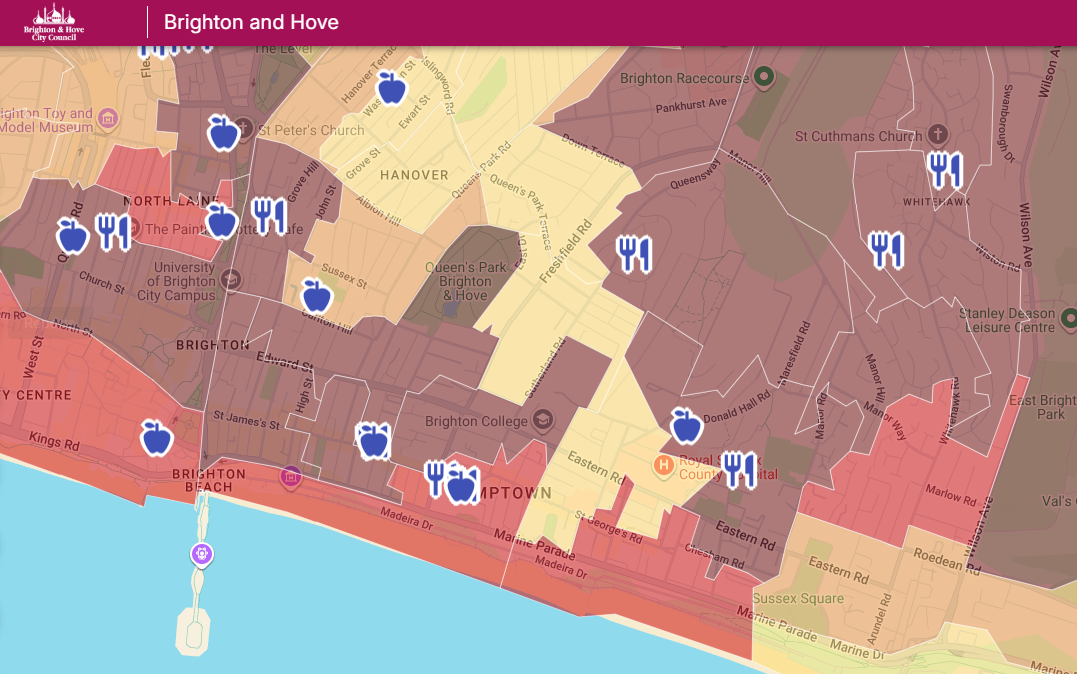
From there, the starting point is often deprivation data, but for programmes that sit at the intersection of food, health and the environment, the team also looks at wider context. “We do a lot around outdoor wellbeing,” she explains. “So things like air quality, green space, parks and what people are able to access are really relevant, especially in areas of deprivation.”
Health indicators also play a big role, Jess adds. “Because food, health and access are so closely linked, having data like this helps when you’re talking to bigger organisations – the council, the NHS, they really want to see that evidence.”
Using the public site has made some tasks for BHFP much easier. “I’ve downloaded those mega spreadsheets before,” Jess says. “Little numbers for different neighbourhoods. And I think a lot of people just go, I’m not doing it.”
“Having a practical map where you can see, oh, that’s the edge of that neighbourhood and that’s what it means, definitely saves time,” she explained.
BHFP can now justify decisions using shared, recognised evidence rather than intuition alone. “It’s evidencing the things you already know,” Jess says, “but giving you the hard numbers.”
BHFP submits funding bids regularly and reports a strong success rate. While outcomes cannot be attributed to a single factor, access to neighbourhood-level evidence is a consistent part of the organisation’s approach. “Having data behind your funding bids is essential,” Jess says. “Your quality of work and the need for it to be expanded are both critical in a funding world.”
The public site also supports more informed conversations with statutory partners.
“They might have the same data,” Jess explains, “but the BHFP lens we bring can offer something different. Poor health in an area often links directly to people not being able to access healthy food.”
That perspective then can feed into planning discussions. “When new housing developments go up,” she says, “we want there to be thought about food growing, local shopping and provision. Seeing the data helps make that case.”
Looking across the city, the team can also respond as needs change. “We’re meeting gaps as they arise rather than them consistently staying there,” Jess says. “Accessing relevant, up-to-date data is a piece of that puzzle.”
BHFP’s experience highlights how widening access to shared local evidence can strengthen partnership working and support better-informed decisions across a city.
Like Brighton and Hove Council, you can enable the partners you work with to access key and relevant place-based data with a Local Insight Public Site. Get in touch to discuss a Public Site add-on to your subscription.
If you don’t have access to Local Insight, and would like to explore how it could work for you, book a free demo today.

The newly launched multi-map analysis feature within the Local Insight platform encourages…
More
You don’t need to spend hours making ward profile reports. If you…
More
There are a number of different methods that can be used to…
More